

Suggested featured image / thumbnail.
TL;DR
Short version: the referral fee is the only Amazon charge that is set by a classification decision rather than by a property of your product, which makes it the only one you can get wrong on paperwork alone. |
Here is an uncomfortable fact about the referral fee. It is not a function of what you sell. It is a function of where Amazon has filed what you sell, and those are not the same thing.
The Rates, and the Spread
Five bands cover most of the catalog.
| Category | Rate |
| Most categories | 15% |
| Consumer electronics, computers, full-size appliances | 8% |
| Automotive and powersports, base equipment power tools, business, industrial and scientific supplies | 12% |
| Jewelry, gift cards, merchant fulfilled services | 20% |
| Amazon device accessories | 45% |
The general range quoted for most sellers is 8% to 15%, which is accurate and also hides the tail. The distance from 8% to 45% is not a variation, it is a different business. On a $40 product it is $3.20 against $18.00.
The full category breakdown, along with the marketplace and exception checks that go with it, is set out in this Amazon referral fee calculator guide.
The Classification Problem Is Not Amazon’s Invention
Sellers tend to treat a category mismatch as an Amazon quirk, or as evidence that someone at Amazon was careless. It is neither. Classifying physical goods into a finite list of categories is a genuinely hard problem, and the difficulty is structural rather than administrative.
The clearest evidence for that is how the federal government handles the same problem for imports. Customs and Border Protection’s guide to tariff classification sets out formal rules for the case where goods are, in its words, “prima facie, classifiable under two or more headings.” It then supplies a written tie-breaker hierarchy: the heading with “the most specific description” wins, and where two headings “equally merit consideration,” the one occurring last in numerical order does.
That is a serious legal apparatus built entirely around the fact that one physical object routinely fits two boxes. A stainless steel water bottle with a Bluetooth temperature display is not obviously kitchen equipment and not obviously consumer electronics, and no amount of care in the listing flow makes that ambiguity disappear.
The lesson to take from it is practical. You are not going to resolve a boundary case by staring at your product. You resolve it by checking what category the listing is actually in and what rate is actually being charged, and by treating a disagreement between those two and your model as a data question rather than an argument.
The Minimum Is a Different Rule
Below a certain price, the percentage stops being the operative charge.
The minimum referral fee is $0.30 per item, and it commonly runs between $0.30 and $0.99 depending on category. The rule of thumb on the destination page is that below roughly $2.00, the minimum will supersede the percentage.
Run it. At 15%, a $2.00 item generates a $0.30 referral fee, exactly the minimum. At $1.50, the percentage would be $0.225 and you still pay $0.30, which is an effective rate of 20%. At $1.00, you pay $0.30 on a dollar, which is 30%.
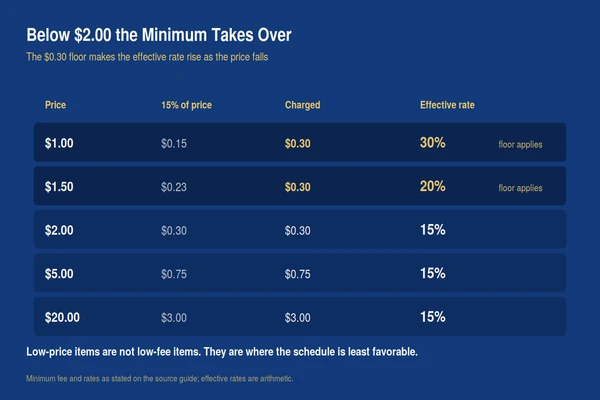
The floor does not scale down with your price, so the effective rate climbs as the price drops.
The effective rate rises as the price falls, which is the opposite of how sellers instinctively model it. Low-price items are not low-fee items. They are the items where the fee schedule is least favorable and least visible, because it is expressed in cents.
Price Points Move More Than the Fee
The other thing worth modeling is what happens to margin as price rises, because the referral fee is the only cost that rises with it.
| Sale price | Referral fee | Net profit per unit |
| $19.99 | $3.00 | $1.99 |
| $24.99 | $3.75 | $6.24 |
| $29.99 | $4.50 | $10.49 |
Read the middle column and the fee looks like the story. Read the right column and it is not. Between $19.99 and $24.99 the fee rose by 75 cents and the profit per unit rose by $4.25, because every other cost in the stack held flat while the price moved.
That is the argument for testing price points inside the calculator rather than assuming the fee scales the pain. It does not. It scales considerably slower than the price does, which is why the thin-margin problem at $19.99 is usually a pricing problem wearing a fee costume.
Three Checks Before You Trust the Number
Check the marketplace. Rates are set per marketplace. A model built on US rates and applied to a European listing is wrong before you enter anything.
Check the category against the live listing. Not against what you selected at creation, and not against what the product obviously is. Against what the listing currently says.
Check the date on your rate table. Using last year’s percentages is the most ordinary error there is, and it produces a model that is confidently wrong in a consistent direction.
The Fee You Can Actually Change
Almost everything else in the fee stack is determined by physics. Weight, dimensions, storage duration, the cost of moving a box.
The referral fee is determined by a classification, and a classification is a record. That makes it the one line in the stack worth auditing rather than accepting, and the audit is short: pull the current category on your five highest-volume listings and compare the rate you are actually charged against the rate in your model.
If they agree, that is twenty minutes well spent. If they do not, you have found the cheapest margin improvement available to you, because correcting it costs nothing.
