

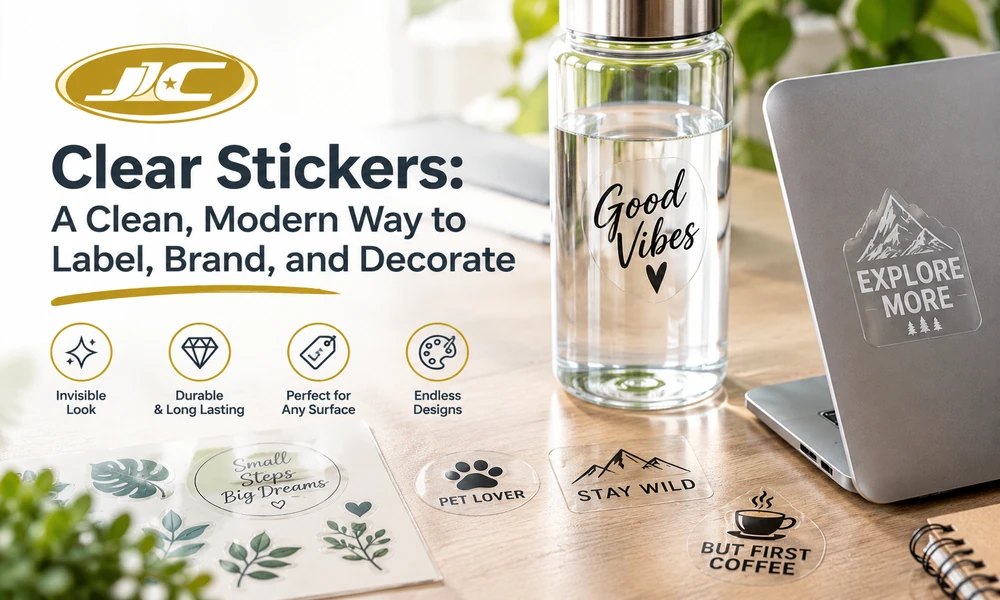
Sometimes the simplest and the best design is letting the product show how good it is. A transparent background label has a logo, name, or message that does not cover whatever surface it is placed. This is also why clear stickers have taken the world by storm among brands, small businesses, shops, as well as people who love creating custom labels.
These stickers can apply to glass, plastic, packaging jars, bottles, and a countless number of other smooth surfaces. These are great looking as a background is still visible around the printing. But the finished result will ultimately depend on the material, your print method, surface color, and how it is intended to be used.
Understanding what transparent stickers really do and how to select the right kind helps deliver results before placing an order.
The Design is Already There but the Background, Not Yet
For example, your average skincare brand slapping a logo on a transparent bottle. A paper label will hide part of the product, while a transparent sticker keeps packaging visible. The logo is still an easy mark to find, and without requiring the addition of a solid block color.
One of the major reasons that businesses prefer clear stickers. They help in giving a very basic look while highlighting the product itself.
They have lot of different functionalities like:
- Packaging designs: Logos, names of products, or nuanced elements in brands.
- Glass jars and bottles: Labels for glass jars and bottles, candles, cosmetics, drinks, and handmade crafts.
- Retail displays: Pricing info, brevity text, and window graphics.
- Customized projects: Gifts and people with storage jars, craft items, or custom decorations.
- Account branding: Order seals and labels for their packaging.
- Business branding: Packaging seals with labels for orders.
What will be the best design to leave on the surface and message. A logo could only require a couple of colors as opposed to a product label with text and additional information.
Transparent Material − What Should You Know
Transparent stickers do not all look or behave the same way. The type of material and the adhesive influences how well a sticker adheres to a surface and its durability.
Clear vinyl
Note that clear vinyl is typically for custom labels and decals. It is ball for smooth inside surfaces; nonetheless it may truly be bought in indoor or outside fashions. Inquire from the supplier about how the material is expected to be used and what it can do.
Transparent film
Other stickers utilize additional clear movies for specific printing or packaging requirements. The standards varied in flexibility, thickness, and durability: the material must suit the task.
Adhesive choice
The surface of the adhesive should be appropriate. A sticker designed for glass could behave very differently when applied to textured plastic or on a curved bottle. If the label must be removed later, inquire about removable adhesive choices.
When ordering clear stickers, inform the supplier where you intend to place them (will they be exposed to sunlight and water?) will they need to remain fixed for a few days/weeks.
The Color Challenge: What is the Outcome on a Clear Background?
An important design detail with transparent stickers is that the surface under the sticker can affect how bright or muted printed colors appear.
So, for example, a dark logo on a white box may be too hard to see on the dark bottle. When printed on a see-through material, bright colors can also fade away.
One way is to layer some white ink under select spots of the design. It can help colors appear opaquer and more vibrant. That said, not every machine offers white ink, and it could alter the price.
Keep in mind that if you will have a design with bright colors/fine text/white elements, ask for a sample or print proof. Use it on the same type of surface and color as you intend to use it.
Glossy or Matte? Choose the Finish with Care
This finish alters the appearance of a sticker in various lighting conditions.
Above, are gloss stickers, the surface texture feels super smooth and shiny. They can work well with bright packaging and designs that require a more professional look.
Matte clear stickers do not reflect a great amount of light in comparison to the glossy ones and would be fit for more minimalistic labels that want to have an overall soft feel. They can also help minimize glare in certain situations.
Ultimately, neither finish will be correct for every project. Your label for a retail shelf may not be a good fit for one on your candle jar or office window.
Before confirming the choice, request the supplier to reveal what types of finishes are prepared.
Make an Easy-to-Read Format
Using the transparent background will make a design look clean but can also reveal how weak your design choices are. You may have difficulty seeing small text, thin lines, or low-contrast colors.
Write out in a clean typeface and have some whitespace around the logo or wording. Keep the main message short. If the sticker has a product name or website, you need to ensure that it will be legible when it is at its final size.
When designing a package, think about how the label will appear when fully filled. Also, this design might look different depending on the color of its contents.
Before the production starts, a proof will serve as a way to check the size, spacing, colors, and layout.
No Guess Order Right Quantity
Sticker prices can vary based on size, shape, material, printing method, and/or finish & order quantity. Added costs would be excited for use of features such as white ink or custom cutting.
If you are comparing suppliers, request quotes based on identical item specifications. Verify whether it also covers art set up, proofing, packaging, and delivery.
Certainly, if you want to launch a new product, a test batch is a way to go. You can use the latter to evaluate how it will look and stick. Store details of approved artwork and material for repeat orders so future runs will match.
Leveraging Transparency for Your Brand
Designed for neat labeling, illustrated decorations on smooth surfaces, and branding without covering the background, clear stickers are a way to stylishly do all of those. For them to be successful they need the proper material, clear artwork, contrast − lots of it, and an adhesive that works with that surface.
Choose the sticker location, review how it appears on that location, examine suppliers based on similar attributes. A sample can be especially helpful for color and transparency.
If you plan them right, clear stickers can create a nice look on packaging and custom projects while maintaining an emphasis on the product.
